Blog · Pricing basics
Recipe Costing 101: Turn Any Recipe Into a Priced Tech Card
Published August 27, 2026 · 7 min read
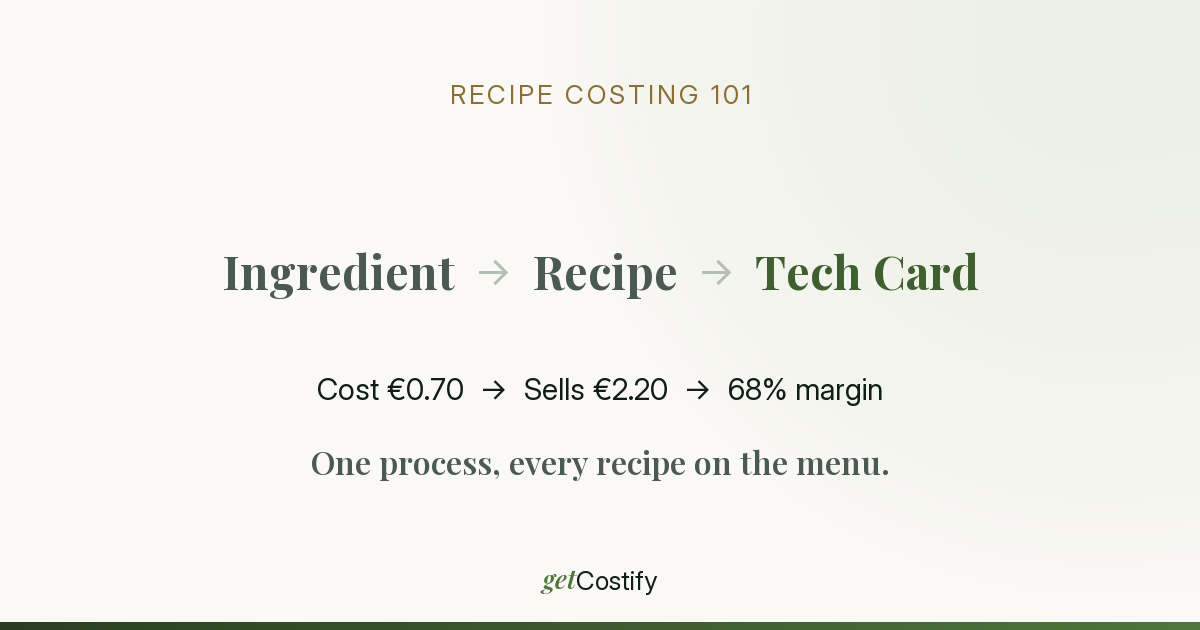
A "tech card" sounds more technical than it is — it's just a recipe with the math attached: what it costs, what it sells for, and what's left over.
Every menu item you sell already has this information hiding inside it. Costing a recipe just means writing it down properly, once, so you never have to guess again. Here's the process, step by step, with a real cappuccino as the example.
Step 1 — Build your ingredient base first
Before costing a single recipe, cost each ingredient once. For every ingredient you buy, you need three things:
- Purchase price — what the whole package costs you
- Package size — how much is in it (weight, volume, or count)
- Loss / yield % — how much is lost to trim, peel, evaporation, or shrinkage before it's usable
From those three numbers you get a net cost per unit — the real cost of one gram, one millilitre, or one piece, after loss. Do this once per ingredient and reuse it in every recipe that needs it, instead of re-deriving it each time.
Step 2 — List the recipe and add it up
A recipe is just a list of ingredients with quantities. Multiply each ingredient's net cost per unit by how much the recipe actually uses, then sum the whole list.
| Ingredient | Quantity | Cost |
|---|---|---|
| Coffee beans | 18 g | €0.32 |
| Milk | 150 ml | €0.12 |
| Cup + lid | 1 | €0.26 |
| Total cost | €0.70 |
Step 3 — Add packaging & overhead, if you track it
Cup and lid above are already ingredient-level packaging. Some businesses go a level further and spread a small overhead allowance (a share of rent, labor, or utilities) across each item too. It's optional, but it makes the final margin closer to what actually lands in the bank, not just what's left after raw ingredients.
Step 4 — Set the price and read the margin
With a total cost of €0.70 and a selling price of €2.20, here's what that recipe actually earns:
Cost
€0.70
Sells for
€2.20
Margin
68%
That 68% is a margin (profit ÷ selling price) — not to be confused with markup, which would be a different number for the same €1.50 of profit. If the terms feel unfamiliar, margin and markup are explained here.
Step 5 — Sanity-check against food/beverage cost %
€0.70 cost on a €2.20 price is a 31.8% beverage cost — reasonable for a coffee drink, though on the higher side of the usual range. If you're not sure what counts as normal for your category, the food cost percentage guide has benchmark ranges by menu type.
Step 6 — the one most spreadsheets skip: keep it updated
This is where a static spreadsheet quietly stops being accurate. Coffee, dairy and packaging prices move. A tech card costed six months ago against old supplier invoices isn't wrong on purpose — it's just measuring a business that no longer exists at today's prices.
A tech card only stays useful if updating one ingredient's price updates every recipe that uses it, automatically. That's the difference between a one-time calculation and something you can actually trust week to week.
Doing this without redoing it every time
GetCostify is built around exactly these six steps: build the ingredient base once, reuse it across recipes, and have cost, margin, markup and food/beverage cost % recalculate instantly whenever a price changes — for both drinks (ml/l/oz) and dishes (g/kg) in the same tool. The free plan covers up to 15 ingredients and 3 recipes, enough to cost out your core menu and see it working before deciding if you need more.
Related reading
GetCostify vs. Excel & Google Sheets for Recipe Costing
Where a spreadsheet holds up, where it starts to break down, and when it's still the right call.
Margin vs. Markup: What's the Difference for Menu Pricing
Same €1 of profit, two different percentages — the math and a conversion table.
How to Calculate Food Cost Percentage (With Formula)
The exact formula, a worked example, and benchmark ranges by menu type.
The Small Pricing Mistake That's Costing You Thousands a Year
A €1 gap between your price and your target margin, multiplied across a year.