Blog · Pricing basics
How to Calculate Food Cost Percentage (With Formula)
Published August 27, 2026 · 6 min read
Food cost percentage is the one number that tells you, at a glance, whether a menu item is priced correctly — before you even look at profit in euros.
It's also one of the most misread numbers on a menu, because it's simple to calculate and easy to calculate wrong. Here's the exact formula, a worked example, what counts as "good," and the mistake that quietly throws the number off for almost everyone who's never had it explained properly.
The formula
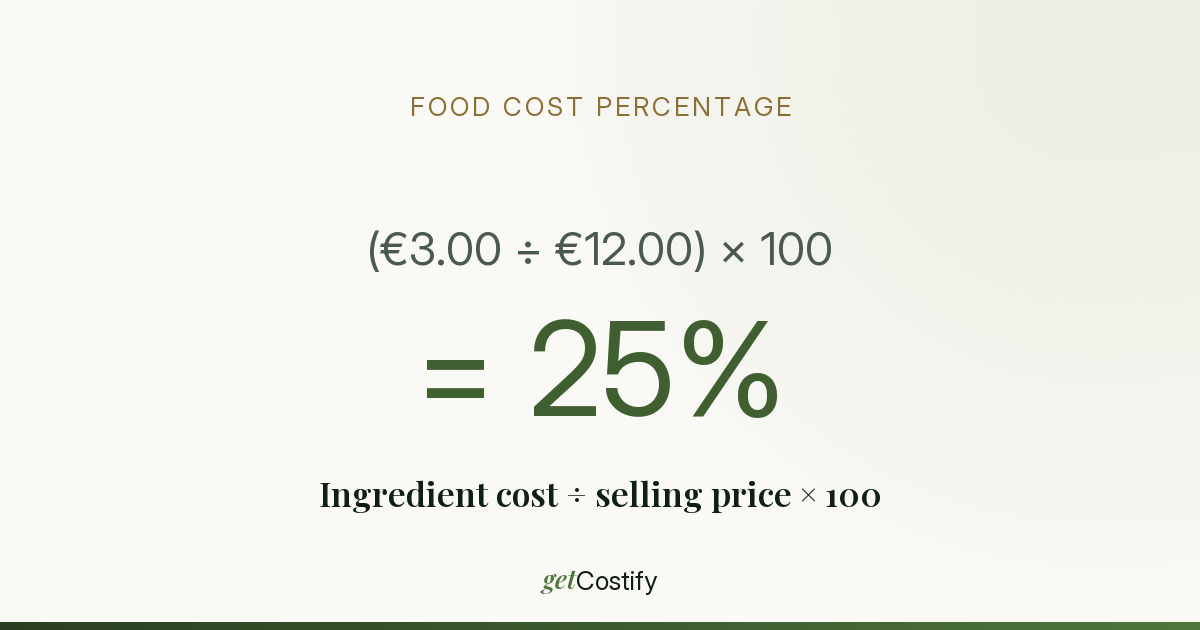
Food Cost % = (Cost of ingredients ÷ Selling price) × 100
That's it — no hidden steps. The only two numbers you need are what the dish costs you to make (every ingredient in it, at the quantity actually used) and what you charge for it.
A worked example
Say a burger uses:
- Beef patty — €1.40
- Bun — €0.35
- Cheese, lettuce, tomato, sauce — €0.65
- Fries side — €0.60
Total ingredient cost: €3.00. You sell it for €12.00.
(€3.00 ÷ €12.00) × 100
= 25%
A 25% food cost means a quarter of what the customer pays goes toward the ingredients — the other 75% covers labor, rent, utilities, packaging, and whatever's left is profit.
What counts as a "good" food cost %
There's no single right answer — it depends heavily on the concept and what the price already covers (a fine-dining plate justifies a higher food cost than a coffee, because the price also pays for a very different level of service and rent). As a rough starting reference:
| Menu type | Typical food cost % |
|---|---|
| Fine dining | 28–35% |
| Casual / full-service dining | 28–32% |
| Fast-casual / quick service | 25–30% |
| Coffee & beverages | 15–25% |
| Bakery items | 15–25% |
Treat these as a starting point to sanity-check a number, not a rule — a coffee shop with unusually high rent might deliberately target the low end of its range, and that's a legitimate business decision as long as it's a decision, not an accident.
The mistake that quietly throws the number off
The formula is simple; getting the ingredient cost right is where most menus go wrong. The usual culprits:
- Forgetting small components. Sauce, garnish, the side, the to-go container — each one is a few cents, but they add up to real percentage points across a whole menu.
- Ignoring loss and yield. A block of cheese loses weight when it's trimmed; produce shrinks when it's peeled. If you cost ingredients at their raw purchase weight instead of what actually ends up on the plate, every dish looks cheaper than it really is.
- Stale prices. Supplier prices move. A food cost % calculated three months ago against today's invoices is measuring a menu that no longer exists.
If a number comes back too high
You've got four real levers, and usually some combination of them is the right answer: raise the price, reduce the portion slightly, swap a costly ingredient for a comparable one, or renegotiate with the supplier. What doesn't work is ignoring it — a food cost % that's quietly drifted 5-10 points above where it should be is one of the most common reasons a busy, popular menu item is still barely profitable.
Try it on your own numbers
Want to run this exact calculation on a real dish without doing the arithmetic by hand? Use the free food cost calculator — no signup, no card, just enter your numbers.
Doing this across a whole menu
The math for one dish is easy by hand. The part that gets tedious is doing it accurately for every ingredient, every recipe, and keeping it updated whenever a supplier price changes — which is exactly what GetCostify is built to handle: enter an ingredient's purchase price and loss % once, reuse it across every recipe, and food cost % recalculates automatically whenever anything changes.
The free plan covers up to 15 ingredients and 3 recipes if you just want to check your current numbers.
Related reading
GetCostify vs. Excel & Google Sheets for Recipe Costing
Where a spreadsheet holds up, where it starts to break down, and when it's still the right call.
Margin vs. Markup: What's the Difference for Menu Pricing
Same €1 of profit, two different percentages — the math and a conversion table.
Recipe Costing 101: Turn Any Recipe Into a Priced Tech Card
A step-by-step walkthrough, with a worked example and the one step most spreadsheets skip.
The Small Pricing Mistake That's Costing You Thousands a Year
A €1 gap between your price and your target margin, multiplied across a year.