Blog · Pricing basics
Margin vs. Markup: What's the Difference for Menu Pricing
Published August 27, 2026 · 5 min read
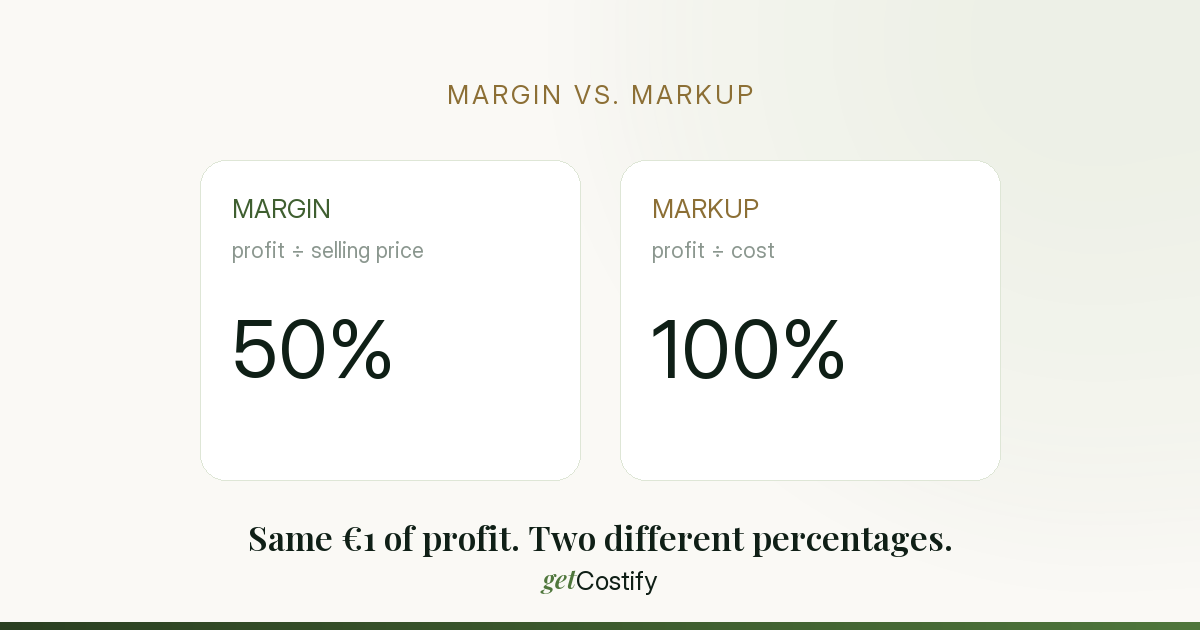
Quick test: your cost on a drink is €1, you sell it for €2. Is that a 50% margin or a 100% markup?
Both, actually — just not the same 50% and the same 100%. Margin and markup describe the exact same €1 of profit, but they're divided by two different numbers. Mix them up when you're setting a price, and you'll usually end up charging less than you meant to.
The actual difference
Both start from the same place: profit = selling price − cost. Where they split is what you divide that profit by.
Margin
profit ÷ selling price
50%
€1 profit on a €2 selling price.
Markup
profit ÷ cost
100%
€1 profit on a €1 cost.
Margin tells you what share of the money coming in the till is profit — it's the number that actually determines how healthy your business is, because it's measured against revenue. Markup tells you how much you added on top of what you paid — it's the number you reach for when you're setting a price, because you start from a cost, not a revenue.
Why this quietly under-prices a menu
Here's the mistake, and it's an easy one to make: someone decides they want "50% profit" on a dish, and — thinking in markup terms without realizing it — adds 50% on top of the cost.
A dish costing €4 becomes €6. That looks right. But €2 profit on a €6 selling price is a 33.3% margin, not 50%. The menu is quietly underpriced by the exact gap between the two numbers — and that gap gets wider the higher the intended margin is.
Run the same mistake across a full menu of 20-30 items, every day, for a year, and it's not a rounding error anymore — it's real money that never showed up in the till.
Markup ↔ margin conversion table
If you're used to thinking in one and need the other, here's the conversion for the numbers that come up most on a menu:
| Markup | Margin |
|---|---|
| 10% | 9.1% |
| 20% | 16.7% |
| 25% | 20% |
| 33.3% | 25% |
| 50% | 33.3% |
| 100% | 50% |
| 150% | 60% |
| 200% | 66.7% |
| 300% | 75% |
| 400% | 80% |
The formulas, if you want to calculate a number that isn't in the table: margin = markup ÷ (1 + markup) and markup = margin ÷ (1 − margin).
The easier fix
The formulas aren't complicated — the problem is remembering which one you're using in the middle of costing out twenty menu items on a Tuesday afternoon. That's the exact gap GetCostify is built to close: enter an ingredient's cost and a target margin, and it calculates the correct selling price for you — no risk of quietly reaching for a markup number instead.
If you'd rather just check your existing prices, the free plan covers up to 15 ingredients and 3 recipes — enough to sanity-check the items on your menu that matter most.
Related reading
GetCostify vs. Excel & Google Sheets for Recipe Costing
Where a spreadsheet holds up, where it starts to break down, and when it's still the right call.
How to Calculate Food Cost Percentage (With Formula)
The exact formula, a worked example, and benchmark ranges by menu type.
Recipe Costing 101: Turn Any Recipe Into a Priced Tech Card
A step-by-step walkthrough, with a worked example and the one step most spreadsheets skip.
The Small Pricing Mistake That's Costing You Thousands a Year
A €1 gap between your price and your target margin, multiplied across a year.